
2026 could be an IPO year for some of the largest private companies ever built - SpaceX, OpenAI, Stripe, Databricks, Anthropic, Canva, Scale AI, and others.
These companies are not like those that defined past IPO cycles. They are larger, more mature, and employ far more people while still private. If even a portion of them go public in 2026, it could mark the largest wave of IPO-driven new tech millionaires to date.
Not because markets are euphoric, but because the math has changed.
For tech employees, IPO-driven wealth is not steady. It comes in clusters. Most years are quiet. A few do the heavy lifting.
This pattern is clearest in tech IPOs. Tech companies rely more on equity compensation, stay private longer, and concentrate wealth creation among employees when liquidity finally arrives.
Industry-level data from Professor Jay Ritter’s Initial Public Offerings: Updated Statistics between 1980 - 2026 shows that only a handful of years since the late 1990s qualify as true peak periods for U.S. tech IPOs, measured by total market value at IPO pricing.
These are the moments when private tech equity converts into publicly priced stock at scale, within a short window.
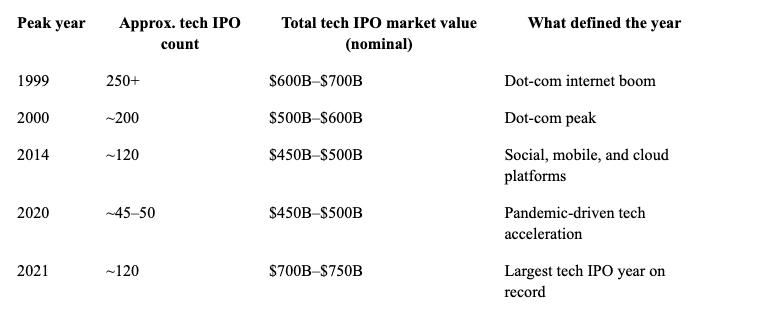
Tech IPO statistics are based on U.S. IPO data by industry from Jay R. Ritter’s Initial Public Offerings: Updated Statistics. Market value reflects nominal dollars at the first day's closing price.
The key point is not just which years made the list. It is how many did not. Many years see steady IPO activity without reaching peak scale. IPO activity began to recover in 2025, but most tech offerings were smaller. The largest private tech companies remained on the sidelines. That backlog is what makes the next cycle worth watching.
Many of the companies behind past legendary IPOs were relatively small when they went public. Their largest wealth creation happened over years of public-market growth, not at the IPO itself.
That is why the next cycle could look different.
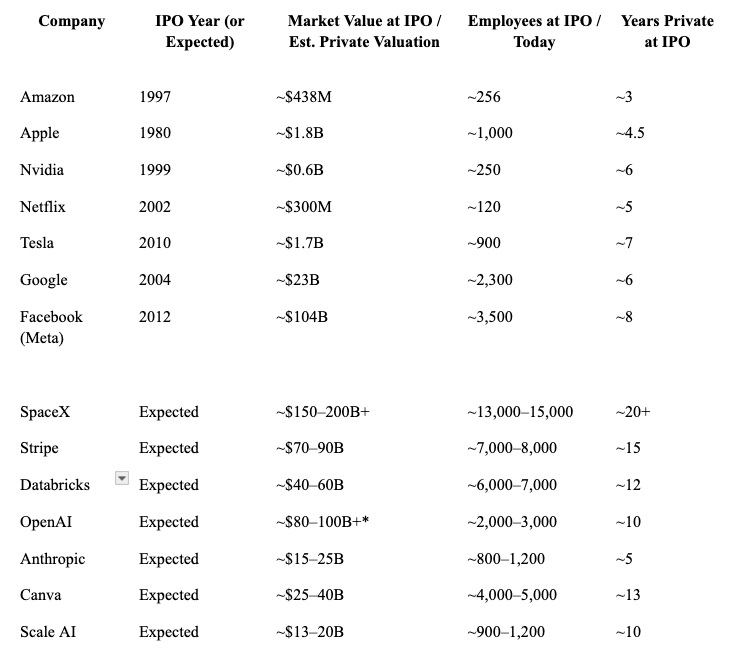
*OpenAI valuation shown for directional comparison only, given its unique structure.
The gap is clear. Many private tech companies today are already larger than Google or Facebook were at IPO. They employ far more people and have spent much longer in the private market.
From an employee equity perspective, a single modern mega-IPO can rival the combined impact of several historic ones.
This pattern becomes tangible in employee option data.
In Equitybee’s data, employees who joined strong private tech companies several years ago often have option strike prices far below today’s implied share values.
Across companies like Databricks, SpaceX, Stripe, and Anthropic, we frequently see:
● Strike prices set multiples below current private valuations
● Employees fully vested with options already deeply in the money
● Big gaps between exercise cost and expected public pricing
For many companies, the value is built before the IPO. Going public is what allows that value to be realized.
Historic tech IPOs often happened four to six years after founding. Many of today’s leading companies have doubled or even tripled that timeline.
Staying private longer allows companies to scale further before going public. They can build more products, reach larger markets, and compound value outside the public spotlight.
It also changes who participates in that value creation. Longer private timelines mean more hiring, more years of vesting, more refresh grants, and broader equity ownership across the company. By the time liquidity arrives, far more of the value has already been created and shared, while the company was still private.
This isn’t a claim that 2026 will have more IPOs than ever before.
It’s because fewer IPOs could unlock more employee equity, involve far more employees per company, and release more accumulated equity per person.
No prior tech IPO cycle combined all three.
IPO moments are not just about upside. They are decision moments.
Exercise timing, taxes, concentration risk, and liquidity planning become urgent considerations. The stakes rise when the numbers are larger, and the window is tighter.
More employees should reach that moment informed, prepared, and with a plan already in place.
2026 doesn’t need to be a blockbuster year to be historic.
If even a few of today’s largest private tech companies go public, the sheer scale of valuation, headcount, and delayed liquidity could produce the biggest wave of IPO-driven new tech millionaires the industry has ever seen.
Not necessarily because the cycle is back, but because the math is different now.